Published Writing
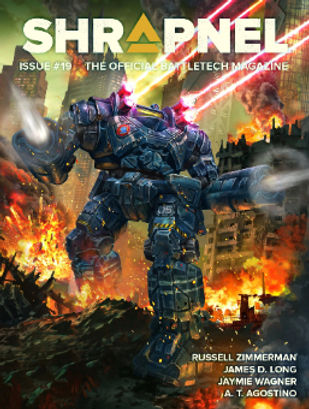
My published writing is in the BattleTech universe, where the popular MechWarrior series of video games is based. I have a short story in Issue 19 of Shrapnel: The Official BattleTech Magazine published by Catalyst Game Labs and a two-part story in Issue 4 of the free fan magazine The Heat Sink published by LutraGaming.
"Just Figure It Out"
Found in Issue # 19
Two BattleMech Techs in the field on a backwater world are under pressure by a demanding MechWarrior to make a major repair without the right tools and only a selection of broken parts to work with.

"Trading in Danger" (Parts 1 &2)
Found in Issue #4
Using the pen name of WMEC906
A mixed group of grunts, two combat vehicles, and a single BattleMech are escorting a convoy of fuel trucks to the coast. Spencer Maddox has to wrangle his outrageous grunts and some surly truckers in order to accomplish his mission. Then there's the small matter of the pirate horde in their way...
Unpublished and Other Work
The Braxis War
This is a novella that was supposed to be a short story for a writing contest on a Discord server I'm on. It was the first piece of original writing I had done in years and really got me interested in creative writing again. It is a very flawed story with a lot of rushed areas and it really shows in the ending. But it really interested me and got me thinking about what this universe would look like. It eventually turned into the Odyssean Reach. Some characters will be appearing there and I will eventually return to this story and make it into something that fits in with the rest of the books I'm planning. Until then, here is a peak at where the Odyssean Reach universe started...
Oya Territory Star System, Union of Earth
Second year of the Braxis War
UES Gallipoli, LSD-611
Task Force 47
Captain Ken Jackson of the Union of Earth Marine Corps watched the holographic display intently as the symbols for the ships of the UE Navy’s Fourth Fleet broke into individual task forces after the last of the Braxis nu Junqi ships had been turned into expanding balls of gas and debris. Task Force 47, the large and ungainly amphibious warfare ships and their smaller escorts that were carrying Jackson and the rest of the Third Marine Division, began moving towards the planet Oya.
Jackson’s dark face remained outwardly neutral but he could feel his heart hammering in his chest from excitement and, if he was honest with himself, more than a little bit of fear. His brain was going a mile a minute and it was all he could do to sit calmly with the other company commanders and senior staff of his battalion, hands resting loosely in his lap, and not fidget like an excited schoolboy.
As he watched, the battleships, battlecruisers, and smaller warships that made up the bulk of Task Forces 41 and 42 angled away from the site of the last ship to ship battle and towards different sections of the asteroid belt hanging between the fifth and sixth planets of the system. Those ships and their onboard Fleet Marine Force were going to “surround and pound” all the resource extraction sites and factories that were imbedded in the belt as well as the shipyards and orbital factories that ringed the fifth planet, the gas giant named Anansi.
Jackson shuddered slightly as he imagined what those Fleet Marines were about to experience. In a few minutes, they were going to be donning their armored combat suits and rigging all their “battle rattle” for the job of landing on a randomly moving hunk of rock with variable gravity and no atmosphere while getting shot at. Two years ago, that would have been him out there with the fleet, hunting for pirate havens or gaining experience through drills and exercises. Large formations like Third MarDiv hadn’t existed before the war, only a handful of regimental-sized Marine Expeditionary Units.
That had changed after the Braxis declared their Klun Braxis do Velt, the “War of Blessed Thought.” A war that had taken not only the humans by surprise but also the Yhena Amera Emis, a matriarchal race of vaguely felinoid bipeds that the Union had been having some border tensions with. Ironically, the Braxis nu Junqi had been acting as mediators between the two races since both the Union and Yhena had shared stiff but relatively cordial relations with them.
“Attention on deck!” A voice rapped out from behind Jackson.
He and the other gathered officers snapped to attention as the battalion commander and executive officer entered the compartment and strode confidently to the front of the briefing room, to a podium at the right of the holographic display.
“At ease, Marines,” Lieutenant Colonel Javier Cervantes said when he reached the podium. “Take your seats.”
There was the sound of shifting feet and the rustle of uniforms as the gathered Marines took their seats again. Cervantes looked towards Major Van Hooten, the battalion S3, with a raised eyebrow and got a firm nod in return. He keyed in a few commands on the podium and the large display shifted from a system view to a close up of Oya, the only habitable planet in the star system.
“Our target,” Cervantes began. “Oya. Goddess of violent storms; wind, thunder, lightning. Also, dead people and children, of all damn things. We’ve been briefed on the stats and trivia but here is the reality.” Cervantes paused and pointed towards the detailed image of Oya without breaking eye contact with his officers. “A live view of a Union world with a population of 30 million souls. Nobody has seen or communicated with those people in over two years. We don’t know what the Braxis have been doing down there. There have been reports and intel analyses but nobody really knows. It could be anything from reeducation and forced labor to mass genocide. Or anything in between. We. Don’t. Know. Today we become the first to find out.”
A tight, expectant silence met the colonel’s words. Every man and woman in that room had studied the planet in front of them for all the months leading up to the liberation of this star system. They knew about the violent storms and winds that girdled the world. The constantly frothing seas and the huge rivers that drained into them. The two major cities, the capital of Shango and the industrial center of Yoruba, which were made up of massively reinforced buildings with slanted walls and rounded corners. And the people, descendants of the African Prosperity Coalition that sponsored the original colony as well as immigrants that were drawn to the violent beauty of the world, that populated those cities and the surrounding enclosed farms and open settlements. Who dressed in bright colors and seemed so satisfied to be taming an alien world.
Ken didn’t know anyone from Oya but he felt like he knew the world. His briefings had been so immersive that he felt an almost physical need to walk on that soil and experience it for himself. He knew he wasn’t alone in this. So many of the officers and enlisted of his company had said similar things as anticipation for the operation had ramped up. They were so close now. So close to booting those crooked backed Braxis off their world. Their world.
“So, the plan remains the same,” Cervantes continued. “It will be updated as new information becomes available but I don’t anticipate any major changes. Since we have no clue of enemy deployment and we want to limit civilian casualties, the Division will drop on Prosperity Plains to the west of the Togo River. Fifth Regiment will be responsible for holding the top of the low ridges in the northwest and act as a blocking force for any Brokeback forces responding from Shango. And Second Battalion, because we’re so goddamned good, will be holding the pass where Highway Thirteen comes up from below.”
Cervantes was rewarded with low chuckles at that last remark. Ken allowed a small smile to show as he brought his company commander’s tablet up and began keying in the Op-plan as his commander went through each detail. Like the others around him, he would make sure that Charlie Company’s deployment matched with the overall orders for his battalion, which should also conform to the Regimental plan, and so on. It was redundant and even inefficient in certain ways but thousands of years of human military history had proven how necessary that redundancy was.
Despite his concentration, Ken’s mind wandered. He kept thinking about the silence of the Braxis nu Junqi. Since the war started, they were called disparagingly “Brokebacks” or “Brokies” because of their unusual morphology. Their torpedo-shaped lower bodies had four short, thin-appearing legs with multiple joints. The spines of the aliens curved abruptly into an extended torso with two arms that looked awkwardly long to human eyes since they had two elbow analogs. In an example of parallel evolution, their heads looked disturbingly human, with hair, eyes, and facial features very similar to a normal human’s but widened and exaggerated. Most humans felt vaguely uncomfortable being face to face with a Brokie and the feeling seemed to be mutual.
The Braxis had been a talkative species before the war. They had talked to the Union. To the Yhena. To several other races and factions. They were enthusiastic proselytizers, always speaking of the Blessed Thoughts of the Universe. In their society, religion wasn’t something discussed or debated. It wasn’t even clear if the Braxis themselves thought of their philosophy as a religion. As best as human diplomats and xenopsychologists could determine, they believed that every sentient being in the universe was a thought of the universe itself. That every race and individual contributed to the mind of a greater being, the Universe, and each life was a reflection of that being’s mind.
Unfortunately for the Union of Earth and the Yhena Amera Emis, their “Thoughts” were polluting the mind of the Universe and something had to be done before permanent damage was inflicted on reality. Whether that “something” was genocide or mass reeducation remained unclear. After the Braxis declaration of war, they completely shut down communication with all other races to focus on their War of Blessed Thought.
Since the Brokie strategy seemed to be to take planets instead of destroying them, Union leaders had to assume that the human populations of those planets were still alive. But, as Colonel Cervantes had pointed out, nobody really knew anything. The Navy had been pushed out of every system they had fought in and had not been able to gain any knowledge as to what was happening during the planetary invasions. The Fleet Marines of TF 41 and 42 would be the first units that would gain any hard intelligence on Brokie ground operations.
UES Aberdeen, CA-907
Task Force 42
“Good job, dumbass,” the corporal said with biting sarcasm, “that was almost as painful to watch as old people fucking.”
“Gimme a break, Corp, the friggin’ nerds keep changing the design of all this crap!”
“It’s a boot, Dixon. Maybe the big brains back home thought you could figure out how to put on a boot. Obviously, they were giving you too much credit.”
Commander Carla Gruber was careful not to grin as she moved past the group of young Marines unnoticed. The arming bay was a hive of activity as the reinforced company of Fleet Marines onboard the UES Aberdeen prepared to go to war. The people of the Aberdeen FMF were already in their “skinnies,” vacuum-rated skinsuits that were made of advanced polymers and tough enough for most working conditions in open space.
Most working conditions, however, did not include combat against rampaging alien invaders that scuttled around on four legs and looked like their backs had been broken and formed into a J. That was why the Marines were strapping on their modular combat armor. The armor was a complex warfighting system that included integral equipment and ammunition carrying capacity, extra onboard air, and a whole laundry list of passive and active technologies that increased the situational awareness of each rifleman as well as their ability to fight together as a unit. The latest version had been redesigned from the ground up to increase its effectiveness against Braxis nu Junqi weapons and technology.
Gruber’s urge to grin left her as she thought about what a bad idea that had been. The all new, completely different suits had arrived only a few weeks prior to their current operation and “her” Marines had barely had time to be checked out in the new features and capabilities. Added to that potential for disaster was the fact that the Combat Armor System, Deep Space Capable, Mod VI was very much an experimental system and it definitely acted like it. There were problems mating gun sights to the onboard ballistic computer, issues with the heat management system that was supposed to keep a fighting Marine cool but also not provide a heat flare to hostile targeting systems, and a multitude of other, smaller problems.
All around her, she saw the signs of people dealing with balky equipment. There were more frowns and sharp words from corporals and sergeants than usual. The lower ranking Marines were obviously frustrated trying to don their suits in the standard allotted time. By the time she reached her destination, Gruber was frowning in thought, all trace of levity long gone from her mind.
“Major Sung,” she said politely in order to announce her presence to the group of suited Marines she had approached.
Major Victor Sung turned and straightened to attention as he saw the ship’s commanding officer. There was nothing casual or informal about the salute he rendered since Sung was every inch a Fleet Marine but there was a certain flare to the honor that added a level of personal respect, not just institutional professionalism.
“Good morning, Captain,” he said in his deep voice. Sung wasn’t an excessively tall man but he was a solid one. His voice added to that solidity, seeming to rumble out of him from somewhere near his feet. “To what do we owe this honor?”
Gruber matched his salute and half rolled her eyes at him. “An honor. Sure, it is.” She then relaxed into a less official posture. “I noticed there are still some issues with the Mod Sixes.”
“A few,” Sung said with a wry grin. He also relaxed as they spoke. The two officers had served together for over a year and had known each other long before, since Sung was an enlisted rifleman before the war. “Honestly, more than a few. But most are non-operational issues like donning techniques and boot-up procedures for the targeting systems. We’re just not good enough at it yet. That’s not something I like to admit but it could be worse. If this was a snapshot engagement where every second counted, we’d be screwed.”
Gruber nodded as she looked around, hands on her hips. “Well, you know better than me. I still don’t like it though. I’ve never heard of a piece of equipment that didn’t take years to fix after it was issued out. In peacetime that might be fine, but the middle of the worst war in a hundred years is not the time to be testing out new gear.”
“No, it’s not,” Sung agreed. “Unfortunately, it’s usually the time when you need new gear. I won’t lie, some of these problems are going to kill Marines. But we know from the limited combat records that the Mod Fives were completely outclassed by the Brokebacks’ tech. We needed these suits.”
“Maybe,” the ship captain said reluctantly. “I knew a gunnery sergeant awhile back. He was always saying that the more you rely on a piece of gear, the more you should test it.”
“Sounds like a smart guy. What ever happened to him?”
“He sold out and took a commission. I hear he’s on some fuck-up’s ship kissing her ass for a promotion.”
Sung’s deep laugh drew the attention of the Marines in the area. They furtively glanced at the two senior officers and then at each other. The tension in the bay seemed to drop a little as they saw their leaders relaxed and confident enough to joke with each other. It may have been a small boost to their morale, but the small things always added up.
“Anyway, that’s not what I came down here for,” Gruber continued. “I wanted to let you know that we got word from Admiral Kincaid’s staff. Army Group Oya is on its way. They’ll be translating into the system in about five days.”
“Excellent,” Sung said, nodding in approval. “I’ll pass the word. We’ll make sure our baby siblings have a safe ride to school.”
Gruber chuckled in agreement. Union military doctrine tasked the Navy and Marine Corps with blowing open a star system and forcing a beachhead on any real estate present. The Army and Near-Space Force was called in if said real estate was big enough to require an extended war on the surface and in close orbit. The Star Guard, the rescue and patrol service of the Union, would assist in convoy escort, special navigation aids, security patrols, and combat search and rescue. It was basically the old United States’ model but adapted for a more advanced space-based warfighting strategy.
“And the ship?” Sung asked after a moment.
“Good,” Gruber said confidently. “you felt the hits we took. Some cracked armor and a few systems got dinged but we’re fully mission capable. A few personnel casualties in sickbay but nothing life threatening. This time.”
UES Aberdeen, CA 907, was an older Osaka-class escort cruiser primarily designed to interdict missiles and fighters before they got to larger capital ships. The Osakas were studded with counter-missile launchers but of an outdated type with a slower firing rate than more modern launchers. Their point defense emplacements were still comprised of projectile autocannons instead of the rapid cycling directed energy batteries that had been standard for over a decade. And they had limited ship-to-ship capability that was made up of dorsal and ventral anti-ship missile tubes and a large bore spinal laser with a very limited forward firing arc. Excellent ships for their time but considered obsolete long before the current war.
“The spirit lives on,” Sung said, intoning the ship’s motto as a mantra.
“The spirit lives on,” Gruber replied, offering her hand. “Good hunting, Major.”
Sung grasped it firmly. “We’ll kill them all, ma’am.”
UES Gallipoli, LSD-611
Task Force 47
Captain Jackson watched with his officers and senior enlisted personnel as the ships of Task Forces 41 and 42 moved into position in the asteroid belt and around Anansi. Quantum communications units eliminated any delay that distance might have added to the transmissions from those ships. They were watching in real time as those Fleet Marines became the first Union troops to assault a Brokeback position.
Everyone was silent as the first Marines swam out of the personnel bays and assumed standard formation before activating their maneuvering packs. There were many different models of the packs but it looked like the assaulting forces were using the low speed/low visibility units powered by inert gas. The LSLVs weren’t exactly stealth grade but they also didn’t highlight the operator with a heat flare or exhaust plume that made them easier targets for targeting systems. They were also easier for inexperienced personnel to operate. With the wartime expansion of the military, which was an important factor to consider.
“Looks like we got a man overboard,” Gunnery Sergeant Kasov from Third Platoon said quietly.
Ken immediately saw what Kasov meant. A lone figure of an armored Marine was moving at an angle away from the rest of his or her squad. The hapless figure was trying to perform the acrobatics taught in basic training to correct for the malfunction or mistake, but to no avail. They looped completely around and started to aim straight back at the cruiser they had just launched from.
“Come on, kid,” one of the other platoon sergeants muttered, “hit your e-stop and wait for the swimmers…”
Ken’s stomach turned into a knot. He wasn’t as experienced as his senior non-commissioned officers but he had been around long enough to see what was going to happen. Either because of panic, rushed training, or a desperate need to get back to his shipmates, the erratically maneuvering rifleman was now on a collision course with the side of an armored warship. The packs might be called “low speed” but that was a relative term. They were still capable of more than three gees of acceleration in short bursts.
If you were still close to the ship you launched from, standard procedure for a loss of thruster control was to activate the emergency stop, which would dump enough gas out of the thruster nozzles to quickly kill most of your acceleration and wait for the Navy rescue swimmers that were deployed with the Marines and stood by waiting for this exact situation. Their more advanced maneuvering packs and specialized training allowed them to quickly intercept and grab an out-of-control shipmate in a safe manner. But that was next to impossible if the person was still under their own thruster power.
There were several winces and sympathetic sounds as the Marine hit the side of the ship while still under two gees of acceleration. The figure seemed to go limp as his thruster, offset from its usual position because of the impact, pushed the figure along the hull like a bug sliding around a vehicle’s windscreen. Several of Ken’s platoon leaders looked away, the young lieutenants unable to watch the disturbing image. Everyone knew that the odds were that they had just watched someone die.
“Can we shift to see the landings on this thing?” Sergeant Major Miller asked in a clinical tone. The company’s senior NCO had her arms crossed and was projecting an air of professional detachment. “I think that would be more useful to see right now.”
“Agreed,” Ken said after subtly clearing his throat. “It’ll be interesting to find out how much the intel briefings got wrong.”
Miller flashed a tight smile and gestured for the controller from the technician running the holodisplay. She handed it over and then retreated out of earshot of the company command staff. The sergeant major input a few commands and the screen shifted from the warship’s hull cameras to drone footage of the combat drop, the information tight beamed back with a narrow beam communications laser to avoid enemy detection.
“I know that cruiser,” Gunny Kasov spoke up again, reading the identification string at the bottom of the video transmission. “That’s the Aberdeen, she’s an old Osaka. I was on her decommissioning crew.”
“Looks like it didn’t stick,” Lieutenant Garrett, his platoon leader, said lightly. “Damn, Gunny, I forget how old you are sometimes.”
Kasov gave the young officer a mock glare and shook his head to the random chuckles around the group. “Yuck it up, chucklefucks,” he muttered darkly.
“Kasov…”
“Sorry, sarn’t major,” the gunnery sergeant responded immediately, not sounding particularly repentant.
Ken smiled faintly but couldn’t bring himself to genuinely feel it. Intellectually, he knew it was a good sign and completely normal in a situation like this but he couldn’t get out of his mind that they were hours away from dropping on an occupied planet with almost no idea of what awaited them. Marine captains weren’t picked for being meek or hesitant but Ken Jackson was very new to his position. In more normal times, he would still be a first lieutenant at this point in his career. One rank difference might not seem like much to an outsider, but the difference in responsibility and the expected professional knowledge was profound.
He could feel the clamminess of his palms and the uncomfortable feeling running up and down his spine. Ken wasn’t afraid for his personal safety. That was on his mind, of course, but in the background of his thoughts. Mostly, he was afraid of not knowing what to do as a combat commander and getting his people killed for no reason. Of freezing when a decision needed to be made right now. The closer they came to the projected load time for the assault shuttles, the more he felt his heart hammer and his stomach get heavier and heavier.
He was concentrating on projecting that confidence he saw in Miller. Be present, be engaged. Say the right things, make the right decisions. He knew how to act the part of a UE Marine Corps company commander but he doubted that he knew how to actually do the job. He was a dedicated young man and thought he was a competent junior officer but this was command. Four rifle platoons, a heavy weapons section, a mortar section, and a headquarters section. Over a hundred and fifty men and women trusting that he would make the right call, no matter the situation they found themselves in.
Ken wasn’t ready. Before the war, there were professional schools and training that were requirements before an officer could assume company command. He had none of them. Not one. In the rush to stand up the Marine Divisions the Union needed to take back their planets, all training was conducted “on the job.” He was shown what was deemed necessary to run a company and then sent on field exercise after field exercise.
Low gravity operations, heavy gravity operations, extreme weather conditions, toxic atmosphere drills, and on, and on. He had made serious mistakes in every exercise. One time, he had ordered the entire company to dig into a hillside and orient themselves to face an enemy that attacked from a completely different direction. Somehow, he had issued the correct orders and turned his entire force in time to meet the threat. In the moment, he couldn’t even remember how. He had spent hours reviewing his battlebox data to figure out the string of orders he had given to accomplish that feat.
Captain Ken Jackson, UEMC, felt like a complete fraud. He prayed that whatever was waiting for him, he would be equal to the task and not let his people down. But in his heart, he doubted that he would be. The only thing he could do was to continue to act the part and do all the things a real company commander would do.
“All right, folks, let’s put our game faces on,” he said in an unconscious imitation of his sergeant major’s tone. “I want all eyes open and all brains switched on. We’re going to want to pay attention to when the FMF meets resistance, how reactive the Brokebacks respond and how good their weapons and sensors are. For all our sakes, let’s hope the Mod Sixes really are better against these assholes’ tech.”
“Roger that, sir.”
“Aye-aye, Skipper.”
“Let’s fucking go, boys!”
“Kasov…”
“Sorry, sarn’t major.”
FMF Aberdeen
Task Force 42
Major Victor Sung winced as the dark asteroid he and the rest of FMF Aberdeen was coasting towards lit up like a New Year’s celebration. Space defense batteries sited on the asteroid below them fired in series so fast that his onboard battle computer, or battlebox, could barely keep up. It wasn’t evident if he was seeing directed energy weapons or hyper velocity kinetic cannon of some sort.
Thankfully, none of the weapons were directed towards his Marines. They were firing from his right to left, tracking the just-slightly-more visible decoy drones that had been launched just before his company swam into their jump off positions. It looked like the low-profile Mod Sixes with their adaptive camouflage features actually were an improvement since the drones were programmed to impersonate a Marine clad in Mod Five armor.
Even after all his years of service, it was still eerie to Sung how infantry combat in space felt. He could see the enemy weapons firing but the beams or projectiles, whichever they were, were moving too fast for the human eye to really track. The light of battle was unexpected. There was no atmospheric friction to make a projectile glow and very little dust or water vapor to fluoresce an energy beam. Explosions, when they happened, were very brief and quickly snuffed out as the oxygen present was consumed. If the object exploding didn’t contain an atmosphere, it sometimes looked like it just randomly smashed into an invisible barrier or just burst from the inside with a few anemic sparks.
But the truly disturbing part was a disconnected feeling of complete isolation because of the lack of sound. There were random lights and sparks, shapes moving just to the side of his field of vision, missile drives activating. Right now, he could see the shark-like shapes of deep space attack craft maneuvering into firing positions and launching ordnance against the enemy batteries. All of it happening to the rhythm of his breathing alone.
He couldn’t talk to anyone since they were on emissions control protocols. He couldn’t hear the rustle of gear or thunder of weapons since no sound could be conducted through a vacuum. He couldn’t even stretch his limbs or flex his muscles because he was on a ballistic glide path and any movement would alter his trajectory. There wasn’t even very much physical sensation of movement aside from what his eyes were telling him, which made some people throw up in their helmets because of extreme motion sickness.
Sung shook these thoughts off as a warning light flashed in his heads-up display. He was nearing the surface of the asteroid that contained the nodal communications and command hub for this section of the belt. The whole reason for assaulting the structures in the belt and around Anansi were to prevent the Braxis forces stuck on them to chuck missiles or bullet-shaped “rocks” at Army Group Oya as they entered the system and passed by in their extremely large and incredibly slow ships. An army transport could make a sluggish amphib look like a ballerina.
A second light illuminated in Sung’s vision. His muscles tensed and his mind cleared of everything but the mission before him. Get his people down, get organized, and proceed to the target. For the next few minutes, nothing else mattered.
When the third and final light lit up, Sung acted. He tucked his legs and performed a forward somersault, kicking his legs straight out at the end. His LSLV pack triggered at the same time. He could feel acceleration forces as he was slowed to an appropriate landing speed. Very suddenly, the veteran Marine’s perspective was changed from falling headfirst down a funhouse labyrinth to hopping down from a small height onto his feet. Immediately, he extended one leg and smoothly transitioned into a zero-gee walk/glide towards the designated company rally point. Small puffs from his LSLV’s shoulder mounted thrusters kept him on the surface of the slowly rotating asteroid.
Things began happening quickly. His radio clicked on and his lieutenants and senior NCOs began making status reports. Everyone was down in roughly the correct area but there were exceptions. Two Marines had experienced thruster malfunctions and had to be picked up by rescue swimmers. One had suffered a seal casualty and died after being exposed to hard vacuum. And a fourth was in critical condition onboard the Aberdeen when she had careened into the side of the hull under a two and a quarter gee acceleration.
But the major didn’t have to issue any orders since his subordinates were already dealing with their issues. The human cost of the operation would be felt later, but right now duties had to be reassigned to take into account the loss of four riflemen. Other Marines came into formation with their commander as Sung continued towards the nearing rally point. On his HUD, he could see his six platoons shake out into their individual squads and fire teams as they all approached the electronic beacon.
Overhead, an attack craft screamed by in complete silence. Hyper-velocity missiles jumped off the stubby wing rails and shot into the distance. Just over the horizon, light blossomed as explosions were born and quickly died. A massive grey wall of dust and vaporized rock burst into existence a kilometer ahead of him and marched from left to right across his vision as the Aberdeen used her point defense autocannons to destroy any sensors, mines, or gun emplacements set up by Braxis forces between his company and the objective. It had the additional benefit of obscuring his troops for a few minutes as they bounded forward in alternating groups.
Sung’s mouth fell open in a feral grin. “Give ‘Em Hell Gruber” was one of the Navy’s last true gunfighters. She had come up through the officer ranks as unguided ballistic and kinetic weapons were being overtaken by the newest generation of “hard light” energy emplacements. That didn’t stop Carla Gruber from mastering her beloved projectiles and cursing out a senior Ordnance Bureau officer in very colorful and highly inappropriate language years ago when he claimed that there was no use for such weapons in a modern battle. The officer got promoted and Gruber got exiled to a backwater region “with the rest of the antiques.”
But now she was in command of one of the last cruisers fitted with such weapons in any number and one of only a handful of squids Victor Sung was comfortable firing a weapon anywhere near ground troops. He could only imagine the comms traffic between Gruber and her squadron commander right now. Colorful and inappropriate would just be her starting point.
The first of his riflemen disappeared in the dust cloud that Aberdeen’s supporting fire had created. A few seconds later, Sung’s HUD went to full overlay as his suit sensors became his eyes. Without the overlay he would have immediately gotten lost in the grey swirl of dust and gravel that was churning around him. He brought his M-35 Advanced Combat Rifle to the underarm position and the aimpoint appeared on his display as his battlebox interpreted the movement. There was a slight drift to the aiming marker but it seemed to steady up after a moment.
Suddenly, he burst through the wall of debris and got his first on scene look at the structure his unit was assaulting. The human made outpost had been modified by the Brokebacks with slabs of armor and knobby protrusions that were either anti-intrusion devices or small shield generators. Thick armored cables stretched across the surface of the edifice and his sensors indicated massive amounts of power running through them. At a glance, it was very obvious that the Braxis nu Junqi, as a race, were leagues ahead of the Union in at least power transmission, if not also generation.
A heavy weapons team finished setting up their man-portable R-13 Anti-Material Railgun System. As soon as it was on target, the gunner fired while his assistant gunner braced him from the recoil. The magnetic round looked like a solid bar of bluish light as it briefly connected the barrel of the railgun to one of the shield emitters. The electromagnetic shield flared as it deflected the round up and to the side but it couldn’t hold out as an entire squad of riflemen and another R-13 team overloaded the emitter.
Squads of Marines stacked up on either side of the cargo airlock doors they were using as access to the structure. Others used entrenching grenades to blow shallow depressions in the rock and take whatever cover they could find. Sung did the same and used his time to monitor the rest of the platoons. Every unit and subunit were at their initial assault points and signaled their readiness.
“Aberdeen Company,” he transmitted, “breach on my mark… Breach, breach, breach!”
UES Aberdeen, CA-907
Task Force 42
Commander Gruber felt the blood drain from her face as all the data feeds coming from Major Sung and every single one of his Marines went dead. One minute everything was normal with data coming in from the battleboxes as usual and the next everything was just gone. A sudden silence fell from the Combat Information Center personnel as the information they relied on to support their deployed Marines was unceremoniously cut off.
“Ms. Harper, Chief Dubois,” Aberdeen’s Operations Officer was the first to mentally recover. “What have you got?”
“Extremely localized and well directed interference across all transmission bands, Ops,” Chief Dubois responded while he was working his console to examine his sensors as well as direct the petty officers of his section. “From the bleed through we’re seeing, they have electronic counter measures that are completely overpowering the battleboxes. There is no way those units are going to win the ECM war, sir.”
“Where’s the power coming from?” Gruber asked as she moved towards the electronics section. “Can we target it or call for the gunships?”
“It’s coming from everywhere, Cap,” Dubois responded in a mix of frustration and amazement. “There’s no one power supply or transmission location. It’s really tough to tell from up here but I think we’re seeing their version of battleboxes.”
“That’s impossible,” Ensign Harper exclaimed in surprise. “Those are the most powerful units we could design.”
“Yeah,” her chief responded, “but it looks like they can do better.”
Gruber stood with an elbow cupped in one hand and the other propped under her chin as Lieutenant Diblasio, her Ops Boss, questioned his two subordinates about what was happening down on the asteroid. The three were trying to figure out ways to assist the Marines and get their electronics back online. Gunsights, Identification Friend/Foe beacons, communications of any sort…all the necessary functions of coordination on a modern battlefield were entirely stripped from her Marine force. And there was no way that they could somehow flip a switch and make such limited equipment as a battlebox more powerful. Hell, from what she was seeing, it would take a warship’s transmitters to punch through the enemy ECM…
“Chief Dubois,” Gruber said suddenly, sharply.
“Captain?”
“Can the Aberdeen’s systems overpower the Braxis jamming?”
The electronics chief looked a bit confused as he replied. “Well, of course, ma’am, but what good would it do? The Marines would still be out of contact with each other. If we let up enough to allow them to use their comms, the Brokeback systems would just overpower them again.”
“Yes,” Gruber said, nodding once. “But we don’t need to do that. I want you and your people to build a map of the facility that we can broadcast out. We’ll get way down in our orbit and park ourselves right on top of them. When we transmit from there, we can use our own systems to pinpoint our people by their electronics signature. Then we populate the map and keep it updated as we transmit. Hopefully, we’ll be able to pick out the Brokie force too. This way, the Marines will at least know where they are and where the bad guys are.”
“Captain,” Diblasio said carefully, “the navigation draft is—”
“Not even remotely a concern,” Gruber cut him off with a wolfish grin. “This is what we’re doing, Ops.”
Fighting the urge to let his shoulders slump, Lieutenant Diblasio nodded. “Aye-aye, ma’am.”
“Right. Ms. Harper, Chief, get your people working on this immediately. I want to be transmitting as soon as possible, no delay. When you’re ready, don’t ask for permission; just start blasting the map out. Understood?”
“Yes, Captain,” they both responded in unison.
“Good. Get it done.” Gruber turned and took two steps to the nearest intercom. “Conn, Combat.”
“Combat, Conn,” her Executive Officer responded immediately.
“XO, it’s the Captain,” she identified herself, “you’ve probably seen that the FMF is getting jammed to hell and gone down there. We’re going to get lower in our orbit on this rock and use our own gear to overpower the jamming.”
There was a slight pause. “Well, it just so happens that I called the BMC up here for a quick conversation and he’s taking the helm right now. Are we talking fudging the nav draft a little or throwing it right out the airlock?”
“Throw it right out the lock, Paul. I don’t mind if we bump bottom but try not to put us completely aground.”
“We’ll definitely try, Cap,” Paul Jansen responded with a grin in his voice.
Even though she wanted to stand and pace around the consoles of CIC, Gruber made herself walk back to her command chair and calmly sit down. It didn’t exactly inspire confidence in the crew if their CO was stalking around like a wild animal and muttering to herself. Everything she needed to see or control could be done from her chair. It was almost as if it was designed that way.
She activated her chair’s display screen as soon as she was situated and set it for the navigation plot. The nav plot was divided in half on the screen, one side showing a top-down view of the ship and the other a representative view from the starboard side. There were icons showing the status and orientation of the main engines as well as all the maneuvering thrusters. A smaller inset image showed the ship’s course as ordered and what it was actually doing.
Lieutenant Commander Jansen wasn’t the best shiphandler yet but he was still very good. He had been her XO since the Aberdeen was recommissioned and he was a competent, hard-working officer. Boatswain’s Mate Chief, or BMC, Arthur Campbell, on the other hand, was a pirate of a chief that had seen a few years of service in the Star Guard but had transferred to the Navy long before the war. He was the most experienced helmsman and small craft coxswain on the ship, maybe even the Task Force. There wasn’t much he hadn’t seen or done when it came to maneuvering.
Gruber told herself that she couldn’t actually feel the ship move as her bridge team maneuvered them closer to the asteroid below. But she certainly thought she could. She forced a relaxed posture as she kept her eyes roving from the nav plot to the external cameras and ranging equipment mounted on both the warship’s hull and from her support drones. She didn’t even flinch as the range to the rock’s surface fell below the minimum navigation draft of her ship, the lowest distance from the ventral hull a ship could be safely maneuvered while in orbit.
Despite the gnawing tension inside her, Gruber felt a thrill course down her spine as her geriatric vessel moved steadily closer to the rocks and shoals underneath. She wished that she could see the look on the face of her squadron commander when she saw what Gruber was doing with a half million-ton heavy cruiser.
UES Gallipoli, LSD-611
Task Force 47
Ken fastened the last of the seals on his skinsuit in the privacy of his quarters. As a company commander he rated his own compartment. It was the size of a shoebox but it was his alone. At times like these, he was almost desperately grateful for it because he didn’t have to worry about watching his body language or guarding his expression. He was free to relax and show as much apprehension or uncertainty as he liked.
There was so much to process from the Battle of the Belt, as some of his peers were calling it. The Union ground forces were definitely going into the fight as second best in too many categories. Electronic warfare and computing power were the most obvious but that hinted at what could be a massive edge in power generation across the board. From the fragmented transmissions and initial reports that Ken and the rest of Third MarDiv had seen, the Brokies used more energy weapons in their infantry forces. Especially rapid-cycling high energy lasers, microwave emitters, and crew-served particle beam rifles.
Ken shuddered as he thought of those microwave weapons. They were being used as area denial weapons or laid as minefields. By the time a running Marine realized that they were in the area of effect, it was usually too late as their body temperature dramatically spiked and they were cooked from the inside in a few seconds. There was no such thing as a pretty death in combat but the still images Ken had seen were absolutely horrifying.
He grabbed his gear bag full of maps, non-networked electronics, and whatever pogie bait he had managed to collect. He had specifically printed out ground maps and communications codebooks after seeing the level of jamming the Brokies had used against the FMF. There was no way he was going to rely solely on electronic file copies when the enemy seemed capable of frying your computers. And the pogie bait was just as important. Jellybeans and chocolate bars were worth their weight in gold when a unit was deployed.
Ken strode down the Gallipoli’s passageway purposefully towards his assigned arming bay. He went over all the order modifications he had issued after the Battle of the Belt. He had made sure that Charlie Company’s supply sergeant had put in for as many foggers, refractors, and reflectors they could get. He knew that the traditional defenses against directed energy weapons were going to be pivotal in their survival on planet. Portable electromagnetic shielding was the best defensive technology the Union could deploy but those units were awkward, heavy as hell, and required a massive amount of power. They weren’t practical for a mobile light infantry force to operate in the field with no pre-constructed fixed structures like bunkers with access to heavy duty generators.
He had also issued orders for every squad to pack extra signal flares and smoke markers. Every rifleman had reviewed the visual communications manual and had been drilled on how to respond to a complete loss of electronic communications and battlebox support. Jackson and his officers and NCOs had only a limited amount of time to react to what they had seen but they used that time to their best abilities. Ken had also made sure that he had sent Major van Hooten a message detailing these precautions. The battalion operations officer had enthusiastically distributed Ken’s message as well as some other orders and contingencies the battalion staff had come up with.
His heart was beating a little bit faster with each step towards the arming bay. His spine was feeling that awful tingling again and his grip was tight on his olive drab gear bag. Ken had a bare handful of combat swims against pirates and possible hostile aliens prior to the war but had seen no action since. No Marine had until this operation. His Division training had been extensive, however, and as close to actual combat as the training cadre were allowed to make it. He had felt reasonably confident in his individual fighting skills, even as he doubted his ability to command a company.
But now that he was walking at a measured pace towards his waiting responsibilities, he felt unprepared in every way. His confidence was retreating as quickly as the looming battle was advancing. The Fleet Marine Force was well trained as well but they suffered major casualties retaking those bases. And they were led by officers who had years of experience in deep space infantry combat actions. Gunnery sergeants, sergeants major, and even warrant officers that had been rapidly promoted to lead platoons and companies of their fellow Marines. Also, they were fighting with doctrine that had been perfected by generations of people who had worn the uniform of the UEMC.
Third Marine Division, or any Marine division, didn’t have that fighting history. The Union of Earth had never invaded a hostile populated planet in its entire history. The ground actions that had been fought were usually conducted by Army and Near Space Force units that were either on-planet in the first place or sent to prepared and secure landing sites to reinforce units already present. Dropping combat troops onto a contested battlefield en masse had not been attempted since the unification of Earth and her original colony worlds.
Sweat began to bead his forehead and the back of his neck as he thought of everything he didn’t know. What he couldn’t know. There were no battles for him to study, no reports to go over. When his company was down and the weapons were firing, he wouldn’t have time to check with Major van Hooten or Colonel Cervantes. It would just be him and his abilities that determined life or death for his unit. And he was quickly realizing that he wasn’t good enough.
As Ken approached the bay, Sergeant Major Miller came up alongside him carrying her own beat-up gear bag. They were both early to put on their armor and other gear but wanted to be able to walk around and check on their subordinates while they armed up. It was also good for morale for the senior leaders to be seen prepared and ready to go as the grunts filed in.
“I was talking with Sergeant Major Bakshi in the Mess yesterday,” Miller said suddenly, referring to the senior enlisted dining and recreation compartment.
“Funny, I didn’t hear you screaming curses through the bulkheads,” Ken replied. Miller’s disdain for Bakshi, the senior NCO of Alpha Company, was well known among the battalion.
“We have this little op coming up. I wanted to play nice.” Ken snorted in amusement as Miller continued. “Anyway, he was bitching about what an absolute potato his company commander was. Which is true, I’ll admit. But then he said I was lucky that I didn’t have anything to worry about over here in Charlie. Can you believe that? The fucking audacity of that man.”
Ken’s stomach clenched tightly at the veteran sergeant’s words. Her tone was light and conversational but maybe that was because she thought it was obvious that he was as unqualified as Captain Stern of Alpha Company. His vision actually narrowed as all his self-doubt seemed to coalesce and overwhelm him. It was all he could do to walk in a straight line.
“I mean, really,” Miller continued, seemingly oblivious to her commander’s sudden distress, “you and I have to deal with Ivan Kasov, that ridiculous collection of broken parts, every day and this asshole is saying we have nothing to do.” Miller waved her free hand in a dismissive gesture. “Yeah, I get it, I’d have it a lot harder if I didn’t have a solid CO, but come on, we’re talking about Kasov here! The man could make rocks cry.”
Ken Jackson felt dizzy as the building tension inside him washed out in a rush. He wanted to laugh and cry at the same time. His emotions were swirling as he slowed to a stop and put a hand against the near bulkhead. He stood there for a moment, vision unfocused, until Miller appeared in front of him, as if by magic. She was so close that he could see the small amount of gray in her blonde hair. Her crow’s feet deepened slightly as her eyes narrowed and bored into his.
“Listen to me closely, Captain Jackson,” she said in a low, intense voice. She poked his chest hard with a knife-hand motion. “Get out of your fucking head and look around you. No other company grade officer gathered their wardroom and NCOs to watch the belt assaults. No other officer outside of battalion thought to emphasize lost comms procedures after seeing, in living fucking color, what Brokie jamming could do. Correction: our fucking battalion staff didn’t do that until you did.”
Ken blinked stupidly at her words. He was the officer; he should be saying something and taking charge of the conversation. Denying his lack of confidence at the very least. But he could only stand there, his own brown eyes unable to look away from her pale blue ones, as she spoke. Stand there a little taller, maybe, as her words sunk into his skull.
“Young officers should question themselves,” Miller was saying now. “They’re young and inexperienced, it would be foolish if they didn’t. But they should also recognize when they’re doing things right. Like you are with this company and these Marines. And they sure as hell shouldn’t analyze themselves into a mental breakdown.”
Miller’s hand dropped away and she glanced around, ensuring the passageway was still empty. She took a step back and turned to continue towards the arming bays. Ken instinctively walked alongside her, back straight but still saying nothing.
“This drop is going to be chaos,” Miller said quietly. “None of us know what we’re doing. Right up to the damn general. But I have faith that you won’t freeze down there. That you’ll do what needs doing. Clear, sir?”
“Clear, Sergeant Major,” Ken responded automatically, almost unthinkingly. But then he relaxed his shoulders slightly and nodded. “Very clear.”
“Good,” Miller said, also nodding. “Good.”
Ken wanted to rub the tight curls of his close-cropped hair but stopped himself before he could. It was a habit he had while lost in thought that he tried to avoid. His older brother had constantly teased him that he was going to rub his hair off when they were kids. He had also said that they didn’t have to worry about sunburns on their black skin from the bright Texas sun. Todd was kind of an asshole like that.
The thought relaxed Ken a bit more. He considered Miller’s words as they walked in silence. As the sergeant major pointed out, young officers were inexperienced. That was why they were paired with senior sergeants in almost every field assignment and told to listen to their feedback. A captain was right on the edge of what was considered a junior officer but at this time in the UEMC’s history, most were woefully unprepared by pre-war standards.
But there was a method to the military’s madness. Those “kid bosses” lacked practical experience but were well educated in general and drilled repeatedly on military history, strategy and advanced tactics, logistics, as well as a host of other areas of military minutia. One of Ken’s instructors had described the relationship as a good sergeant guiding his platoon leader around the trees while the officer was managing the forest.
And Ken suddenly realized that he was managing the forest as well or better than his peers. Not expertly, by any means, but well enough that he was trusted by his subordinates to put them in roughly the right place in order to give them a fighting chance of success or at least survival. Apparently, well enough that grizzled sergeants, however annoying they were, in other companies considered him competent.
Miller’s aggressive pep talk hadn’t magically banished his doubts since he could still feel them roiling below the surface of his thoughts. In fact, her assertion that the operation was going to be chaos added even more worries to his running list. But she had succeeded in shocking him into a different point of view and allowed his analytical brain to be engaged. Instead of being drowned in his fears and mentally recoiling from his responsibilities, he was now considering those fears in a more rational light.
Fear was a natural response to situations, an instinct that was honed through thousands of years of evolution to warn a person when they were in danger and needed to take action. It was an essential survival instinct that had been honed over thousands of years of evolution. But terror was a different thing entirely. It was fear’s irrational twin. Terror could paralyze a person in thought and deed. It turned brave men and women into cowards. It was a swamp of indecision that Ken had been very close to getting mired in.
“That extra hour for dressing out was a good idea, sir,” Miller said after a few strides, glancing appraisingly at her CO out of the corner of her eye.
“I hope it’s enough,” Ken said after a moment. “I don’t want to sound critical, but the Fleet Marines looked a little frazzled getting in harness.”
“Just a bit,” Miller agreed. “And don’t worry, I’m sure we’ll find new and interesting ways to fuck things up.”
Fifteen minutes later, Ken was wishing that Miller wasn’t right so much of the time. Sergeants were knife-handing their corporals, corporals were glaring at lance corporals, and everyone was correcting the privates. Armory technicians were “moving with a purpose” from group to group with diagnostic gear and fitting tools. And through it all, overhead speakers were calling out the readiness status of each landing shuttle and drop pod. Everywhere he looked, Ken was seeing organized chaos.
“Gunny Kasov, the heavy weapons team just lost all their datalinks to the Ell-Tee’s battlebox.”
“Lieutenant Dwyer! Second Lieutenant Dwyer of Third Platoon, Alpha Company! If you are here, you are wrong!”
“Moshe, you blithering idiot, get off my foot!”
“For the last time, fuckface, I’m not sending my squad back to the Rigging Shop for LSLVs because we’re using a goddamn landing craft!”
Thirty minutes into the process Ken saw that, despite appearances in certain areas, they had learned some lessons from the FMF arming procedures. It was hard to describe to outsiders, but even the most grueling training deployment could not stress men or equipment as much as even a minor combat operation. And this was far from a minor op. In training, there were still limits and protections that were not exceeded because of safety of the personnel or consideration of the wear and tear put on equipment. Added to that, some crafty NCO or alert company officer would usually sniff out what the training mission was supposed to accomplish and stack the deck in their favor for gear selection and personnel assignment.
But this was the real deal. Staff Sergeant Knows Everybody couldn’t buy his old Braxis pal Grig Grog a drink at the bar and pump him for information. Second Lieutenant What’s Her Name wasn’t going to be accidentally emailed a copy of the opposing force deployment plan. Training was critically important for a military unit and even more so when that unit was as collectively inexperienced as Third MarDiv. Combat, however, simply could not be replicated completely no matter how tough or realistic the training program.
Training always left gaps and it was up to experienced leaders to fill those gaps. Unfortunately, that was easier said than done when the majority of your leaders came from a peacetime force with limited combat experience. That was not an excuse to simply shrug and not try, however. There were officers like Ken Jackson with the foresight to anticipate where those training gaps may lie and NCOs like Christine Miller who had enough experience getting shot at to correct issues before they could become major problems.
All things considered; Ken was pleased by the performance of his people. He spoke to his platoon leaders and their gunnery sergeants, issued a few minor corrections as he walked through the company area, but mostly he just concentrated on making eye contact and acknowledging his Marines as he strode by. His emotions were under control but he still felt a singing tension as the time to load the landing craft closed in.
He stood with Miller in the cavernous loading bay as his company filed in and broke into platoons and squads. The landing craft would load two squads each, half of a platoon, with the platoon leader and platoon sergeant split up. His Headquarters Section was also split. Ken and Miller would be on one craft while First Lieutenant Morgan and Staff Sergeant Santiago would be on another. The Army had massive troop transports that could load up to a battalion of infantry or more but it was decided that the Marine Corps didn’t want anything that large for initial planetary landings. One shot in the right place could take out a third of a regiment of Marines.
The loading bays of the Gallipoli were segregated at the moment, each company of the battalions that made up the Fifth Marine Regiment having their own pressurized section. Once the companies loaded, the airtight bulkheads separating each section would retract into the open position. Then the bay would be quickly depressurized as both ends were opened to space. The support and securing cradles around each craft, already powered up and standing by for launch, would be disconnected and also retract into the overhead. Then launch operations would begin as the hundreds of shuttles that carried the Fifth Regiment would stream out of the landing bay.
And the UES Gallipoli was only one of four massive amphibious warfare ships that formed the heart of Task Force 47. There were also two of the slightly smaller LCA ships, UES Commando and UES Gangut. The Landing Craft, Assault ships could also haul ground troops to a battle but on this operation were specifically tasked to launch the modified assault craft that would provide close air support for the grounded Marines. When the Marine Division concept was developed at UE Joint Fleet Command, it was determined that these rugged and heavily armed gunships would eliminate the need for the dedicated fighters and bombers of the Near-Space Force as well as the need to waste precious cargo space on the heavy artillery units the Army used.
Ken strode towards the lander at the head of the formation after the last of his last riflemen filed past him. His movements were bold and confident as he donned his Mod Six helmet and engaged the seals. Every Marine would drop sealed up and probably stay that way through the first hours of being on planet. There was no telling what chemical or biological agents the Brokebacks might use on the battlefield.
Once his helmet was in place and the HUD once again flared to life, Ken brought the battalion feeds online using the command interface on his gauntlet. He signaled his unit as fully loaded and ready as his boots clanged up the ramp and into the armored pillbox attached to the spine of the landing craft. He sat in the heavily reinforced dropseat waiting for him and secured the five-point harness that would help keep him in the seat in case of turbulence or extreme combat maneuvers.
The pillboxes were what the landing craft actually dropped when they got close enough to the surface of the planet. They were layered in the latest armor and low-emission materials and filled with ammunition, food and medical supplies, equipment spares, as well as drone operation centers and various other important items. They were designed to form a battlefield web of C3I capability to enhance the effectiveness of the Marine forces. C3I stood for command, control, communications, and information. For hundreds of years that concept had been integral to human warfighting doctrine.
Each pillbox could be outfitted to support a variety of troops. From headquarters sections to heavy weapons units or standard rifle platoons. The supplies and additional equipment could be easily loaded onto hover pallets and travel with the logistics specialists as the Marines deployed to different areas of the battlefield. The remaining pillbox structure could then be placed into standby status or rapidly disassembled and rendered useless to the enemy if that became necessary.
“Traveler Two Zero One, this is Rancher Six,” Cervantes transmitted to the lead shuttle. Traveler was the call-sign for the landing craft wing while Rancher was the battalion handle.
“Aaand Rancher Six, from the Two Zero One. Go ahead.”
Ken rolled his eyes. Pilot radio etiquette always annoyed him.
“Two Zero One, all Rancher elements are loaded and locked in. We are ready for launch, over.”
“Roger, Rancher Six. Be advised, we’re under a short delay until cleared from the Task Force ATO.”
There were further radio exchanges as the battalion commander acknowledged the squadron leader. Each of the big amphibs had an Air Traffic Officer, or Air Boss, which was the ship’s officer that coordinated flight operations among the dozens of shuttles. Then there was the Task Force Air Boss aboard the flagship, UES Barbary, whose job was to supervise the launch and coordination of every single small craft among the Task Force. It was a monumental assignment that Ken wouldn’t wish on anybody.
He closed his eyes as the communications channels went silent. For a few brief moments, he found that he could finally relax. All the tasks were done, the timelines met. Orders had been given and received. Everybody was in place and waiting quietly, alone with their comrades. Oddly, he suddenly wondered what his brother was doing today and if Todd was also thinking of him. Despite the constant thrumming of an active starship and the deeper bass growl of the landing craft, it was an oddly peaceful moment.
It didn’t last.
Jolted back to reality, Ken willed himself to not physically flinch as the support cradle snapped open with a metallic screech followed by a heavy boom. The landing craft he was on immediately lifted into a hover only a few feet off the deck of the landing bay. The artificial gravity field of the Gallipoli was still acting on them but it wouldn’t be long until the craft was outside the skin of the ship and on its own.
He slowly opened his eyes and looked around at the other Marines in the pillbox. Miller seemed to be studying a report on her HUD as her eyes twitched, following the stream of data. Collins, his communications specialist, was gripping the arms on his dropseat and had his eyes oddly squinted, trying not to look scared to death. Some Marines seemed to be breathing heavier than others but all seemed to at least be pretending a certain level of ease. Everything seemed to pause for a moment, a snapshot in time.
Sudden acceleration pressed them all into their seats. In the launch position, all the dropseats were locked facing forward to reduce disorientation in zero-g climates. Ken brought up a view from the landing craft’s nose camera as it shot out of the bay at launch speed and immediately transitioned into a rolling dive, following it’s brethren as they tumbled out of the massive LSD and fell towards the planet below. The image blurred, tilted, and spun crazily as the pilots maneuvered seemingly at random into a formation designed to deceive enemy sensors and keep the shuttles on unpredictable paths.
Ken quickly shut the camera feed down. Going from the gravity of the Gallipoli to the acceleration of the craft had confused his inner ear and the images from the camera didn’t quite line up with the pulls and jerks he was experiencing. He felt his gorge rise as he tried to control his stomach. His body was being pulled like taffy through three dimensions and so many different angles that he quickly gave up trying to predict where the next force would be felt.
At his place in the center of the pillbox he could see the Marines beside him and in front of him. He saw more than a few hunch their shoulders and duck their heads as they vomited inside their armored helmets. Seeing this Ken couldn’t help himself; he spewed his stomach contents all over his visor as his inner ear struggled to figure out what was going on.
The suit’s anti-organic systems immediately went to work. High pressure air nozzles and jets of quick drying cleaner rinsed the visor in seconds and the detritus was vacuumed into a small intake by his throat. For a few seconds, he scarcely noticed the jolts, drops, and bucking he was subjected to.
Ken suddenly realized that the environment was changing around him and it had been building almost subliminally until his mind noticed it. The engines had slowly changed from their deep bass growl to a higher, full-throated roar. The kaleidoscope of g-forces was settling into a more predictable orientation with less dramatic changes. The hull of the pillbox was pinging and popping as its exterior was subjected to the incredible heat of reentry. The Fifth Marine Regiment, Third Marine Division was officially in Oya’s atmosphere.
The landing craft slowed from their astronomical speeds as they penetrated the planet’s exosphere. As atmospheric pressure increased, so did friction. The LC-10 Condors the Marines were riding in were made of advanced materials and equipped with the latest in miniaturized shielding but there were limits to the technology. They increased the theoretical top speed an object could travel in atmosphere but there were still limits. If those limits were exceeded, the reentry vehicles would suffer catastrophic failures.
Maneuverability was also an issue. The higher the speed of the now-aircraft, the more stress was put on the frame. It was simply impossible to design an airframe heavy enough to withstand the forces of radical maneuvers at hypersonic speeds. The small shield generators jammed into the LC-10’s spine were an improvement over previous models but were really only proof against relatively small warhead fragments or light directed energy weapons that had already been attenuated by distance or atmospheric interference. They would be of little use against direct hits from any serious weapon system.
With the advent of lightspeed and near-lightspeed weaponry, the old adage of “speed is armor, speed is life” didn’t apply as much anymore. At least in atmosphere. Any combat vehicle expected to operate in atmosphere was designed with a special emphasis on maneuverability combined with active and passive defensive features, such as powerful ECM and the new shield generators. It was felt by designers and senior military planners that any speed advantage could be gained by simply pitching the craft towards the ground.
That was why the swarms of Condors all started twisting and turning crazily as their downward-arced wings hit thicker air. They dove, swooped, and looped in a mad dance that was planned and executed by brilliant computer programs with the flight crews standing by in case of emergency. Since true computer AI was still the stuff of science fiction, the living beings in the cockpits were also there to respond to any unforeseen events that the computers couldn’t handle because of software limitations or battle damage.
It wasn’t very pleasant for the Marines strapped to their seats in the pillboxes. The Mod Sixes were equipped with the latest in automatic medical monitoring and intervention but there was no drug or intervention in the known galaxy that could prevent a human from hurling their guts out under those conditions. They were in a mach speed elevator car with no windows that had been booted into the air by an angry giant. Human physiology was not equipped to deal with those conditions.
As the squadrons of shuttles carrying the first wave of Marines dropped through the planet’s mesosphere and into the upper edges of the stratosphere, the first electronic fingers began reaching invisibly from the planet’s surface. Surprisingly, sensors from the Union ships in orbit also began catching whispers of Brokie tracking systems from satellites in extremely low orbits that had gone undetected against the full array of human detection tools. The planet had seemed to be completely asleep since Fourth Fleet had blasted the last enemy ship from space but it now appeared to be waking up.
3rd MarDiv Operations Center
UES Cyprus, LSD-615
Task Force 47
Major General Sir Charles Darby-Jones felt the first stirrings of unease as the electronics war began over Oya. He had reviewed the boarding actions that the Fleet Marine Force units had fought and came to the same conclusions a lot of other people had; Braxis technology was extremely advanced in energy generation and use as well as having a definitive edge in computing power.
The overall effectiveness of their electronics in general came as a surprise because there was little indication of that dominance prior to the war. Relations with the Braxis nu Junqi had always been cordial and there had been cultural missions between the two races for almost fifty years. Their power plants and computer devices were physically smaller than their Union counterparts but the actual capabilities seemed to be analogous. Apparently, the Brokie bastards had been holding out on their human “friends.”
Now, surrounded by his officers and enlisted specialists, General Darby-Jones worried. He worried about things he knew that he didn’t know and, most especially, he worried about things he didn’t know that he didn’t know. The complete negation of the FMF’s communications and embedded computer support had been a shock to everyone. If that wonderfully recalcitrant Commander Gruber hadn’t been so quick off the mark in her assessment and reaction, many more Fleet Marines would have died.
That was why he had requested that Aberdeen be temporarily transferred to Task Force 47, so he could examine the data from the Battle of the Belt directly and have those Navy and Marine personnel on hand to answer questions and give him a more detailed account of how the Braxis forces responded to the assault.
Darby-Jones may have been a Marine officer, but he had spent more time in space than some Navy admirals. His mind was beginning to make connections between the vicious losses the Navy was taking in this war and what had happened to his Fleet Marines. If the Braxis warships had access to such computing power, it was no wonder they had rolled over eight Union and eleven Yhena system defense forces with such speed.
Computers were powerful force multipliers. They didn’t just crunch targeting data or run automated electronic warfare programs. Computers were integral to several different types of directed energy weapons. They would take data from thousands of different sensors spread between warships, drones, fighters, and even anti-ship missiles to analyze a target’s physical properties, shield spectrum, and many other factors to tailor each shot for maximum effectiveness. They could enhance broken and disrupted battlefield communications to turn high pitched static into comprehensible orders. Computer-assisted stealth systems could turn the physical and electronic footprint of a full-sized warship into something half their actual size.
And that advantage was coupled with superior power generation and, presumably, storage. All that computing power coupled with stronger mass drivers, extremely high energy beam weapons, capacitors for missile or torpedo drives. It was painting a grim picture in the mind of the senior Marine commander.
“Colonel Dupres,” Darby-Jones said, calling the commander of his landing craft forces, “How many Ell-Cee decoys do we have available for rapid deployment?”
“One moment, General,” the colonel replied. After a moment, he had the answer. “Enough to emulate two squadrons, sir.”
“Only two?”
“Yes, general. We could reload more decoys from storage into the drone launchers but it would take about forty-five minutes to prep them.”
Darby-Jones didn’t hesitate. His gut was telling him his people were going to need those decoys. “Launch the available decoys now. Get as many from storage as you can beginning immediately. And talk to the Navy. See if they can get any EW missiles into the atmosphere.”
“Aya-aye, General,” Colonel Dupres responded crisply. He was obviously surprised by the sudden orders but, to his credit, did not hesitate to carry them out.
Traveler Five Oh Three, an LC-10 Condor
Charlie Company, 2nd Battalion/5th Marines
Ken never found out the exact moment when the carefully planned invasion turned into a complete and total clusterfuck. It was almost impossible to tell from the inside of his pillbox since the deliberate aerial maneuvers seemed like pure chaos anyway. There were several computer screens surrounding his commander’s dropseat that showed depictions of the other Condors carrying his company as well as smaller icons for the rest of the battalion. They were all happily glowing green throughout the violent motions.
Then one turned red. Then another. Then two more. They were being shot at by the Brokies. Not just shot at, they were being hit. Hard. Icons were turning yellow and red with alarming speed. Information began streaming across his screens. The feed from Lieutenant Colonel Cervantes’ battlebox cut out and was quickly followed by Major Van Hooten’s. Ken was now second in command of the battalion. Another blaze of red. Ken was now in command.
Outside of Ken Jackson’s pillbox, the airspace around Fifth Regiment was thick with weapons fire. Missiles and beam weapons were arrowing in from below and above. Stealthed satellites and weapons platforms were screaming to life and firing beam after beam. Groundside missile launchers opened up from concealed locations placed strategically to cover Prosperity Plains, the most likely landing spot for the Union Marines on the continent.
Human pilots began overriding their computer controls. The evasive maneuvers were not pre-programmed, but the results of adaptive programming. Autopilots “saw” the battlefield and executed maneuvers based on that view. But they also kept trying to direct the Condors towards their designated landing zones. Which made them predictable to enemy computers that could collect more data, process it faster, and devise fire plans at speeds that were completely unmatched by any human computer network in existence.
The entire formation of landing craft began moving east as the pilots instinctively shied away from the fire sack that had been prepared for them. As that was happening, the first decoy drones arrived in the area. They immediately came to life and mixed in with the squadrons of actual Condors, becoming indistinguishable from the real craft. A few seconds later, a handful of big, hulking shipboard missiles fell through the atmosphere, their drives unneeded in a gravity well. Their EW warheads strobed out powerful microwave bursts that disrupted electronic signals in a large radius. Their paths kept them well clear of the landing craft but formed a huge rough circle around them in order to blind enemy targeting and tracking sensors.
“Cavvy Six, Cavvy Six, this is Traveler Two Zero Nine!”
“Two Zero Nine, Cavvy Six,” Ken replied, answering to his call-sign. He was darkly amused to realize that the typical pilot drawl was nowhere in Two Zero Nine’s voice.
“Cavvy, we’re drifting away from the main formation and can’t climb out of atmo! There’s too much firepower above us! We’re going to dive low as fast as we can and try for the landing zone!” Ken wasn’t as amused as he realized the pilot in command of his battalion’s Condors was right on the edge of full-blown panic.
“Negative, negative!” Ken responded immediately. He had called up a map of the region a few seconds ago. “The primary Ell-Zee is a no-go! Head for the west bank of the Togo River! I say again, I want my battalion on the west bank of the Togo!”
“That’s not the plan, Cavvy! You won’t have any pre-planned support!”
“There is no plan, Traveler,” Ken shot back, “it just got blown to hell! Put us in the pinned location! Now! And mark the position for all other landers! I want as many birds as possible to drop right there!”
“Roger, Cavvy Six,” the pilot responded. She seemed steadier after getting clear directions from a firm voice that seemed to know what it was doing. “We are inbound to the west bank of the Togo River.”
Ken acknowledged but was no longer paying attention to the conversation. He had seen the outline of the Togo River and the surrounding area and had made his choice almost without conscious thought. He had thrown out the primary landing zone immediately. If the damned Brokies had set up this kind of ambush in the air, then Prosperity Plains would be nothing but a killing field. He didn’t even want to imagine the kinds of hell those alien pricks had waiting for them.
The swampy area next to one of Oya’s biggest rivers was the only choice for the kind of fight Ken wanted. Small atolls of dirt and moss covered in trees and shrub brush, separated by mud and dark, fetid water. Just enough real estate for the armored pillboxes to command the limited high ground and force the enemy into slogging attacks through sucking mud and clinging water. Foggy conditions with air thick with moisture. A perfect environment to multiply the effects of the Marines’ anti-energy weapon defenses and turn the Brokie’s seeming love of energy weapons into a deadly weakness.
The raging river at his back would secure at least one of the battalion’s flanks and provide access to drinking water if needed. The terrain itself would impede any ground vehicles the Braxis forces might bring to the battle, slowing them down and making them inviting targets for…someone. He hoped. It was also an unexpected geographic choice. There was no way an invasion force could conduct quick, lightning raids out of terrain like that.
But Ken had realized that he didn’t have to. All he had to do was get down there and get dug in. Either the enemy would come to him and they would get into a mud wrestling match, tying down large amounts of the Brokie’s limited number of troops, or they wouldn’t and the Union would have a secure beachhead to pour more troops into and slowly expand out of. In either scenario, all Ken and his battalion had to do was play for time and hold on until reinforcements could arrive.
The interior of the pillbox was suddenly bathed in the soft, orange-tinted light of the amber warning beacon of imminent drop.
“Captain Jackson?” Miller’s voice came through a private channel she had opened up.
“Yes, Sergeant Major?”
“Am I to understand we’ll be fighting in a swamp now, sir?”
“Um, yes, Top. That’s the new plan,” Ken responded guardedly.
“Excellent, sir, good thinking. Do you think anyone else might need some, I don’t know, clarification on the new situation?”
Belatedly, Ken realized that he hadn’t said a word about his plan to any Marine under his command. “Actually, I was just getting to that.”
“Of course, sir. Sorry to interrupt.”
It was truly amazing how deflating a good NCO could be while being perfectly respectful. With a wry twist of his lips, Ken composed himself then opened a general comm link to all the Marines in Second Battalion as well as whatever units were headed to his landing marker.
“Marines headed to the swamps of the Togo, this is Captain Jackson, now in command of Second Battalion. We are ditching the op plan that we were all briefed on. As of this moment, there is no op plan. My intention is to ground in the swamps and organize a defense in depth perimeter using the pillboxes and individual units. We will break down into platoons and take up mutually supporting positions. Expect loss of communications. Expect your battleboxes to get jammed. Remember, we are Marine riflemen! The only thing we need to hit a target is one eye and a rifle sight!”
Ken took a breath. He paused as he glanced at his screens and saw that they were moments away from the Condors dropping the pillboxes the last few hundred meters onto Oya.
“My plan is for this fight to be close and mean. I want us to grab those assholes by the belt and chew on their fucking necks! When you’re in your zone and you find yourself out of communication and don’t know what to do: attack! If you’re in a jumble and it’s a mess, fall back a short distance and regroup. Then attack! Stay aggressive but stay smart! Keep in supporting position of your neighboring units! We’re going to put those bastards off balance and on the defensive!
“This is our swamp! And those Brokeback fucks are going to have to pay in blood if they want it!”
In the cockpit of the Condor, the flight crew was operating completely on training and instinct. Missiles were screaming past at shocking speeds. The atmosphere bent and twisted in front of their eyes as beam weapons flashed all around them. Commands were rapped out quickly, reports and call-backs were given almost without thought, and human hands manipulated controls with reckless speed. There was none of the formal, careful precision and deliberate motions that categorized normal flight operations.
As the shuttle approached its new deployment point, the dropmaster was breathing heavily as she stared at the position screen with her hands on either side of her console. She had already pulled the red safety knob in the top left corner and set it to the Emergency Drop position, bypassing all redundant inputs and safety protocols. As soon as the shuttle’s icon merged with the pinned position, she reached for the two throttle-like controls in the middle of her panel and yanked them back in a quick, adrenaline-fueled motion.
On the exterior of the Condor, heavy duty clamps snapped open at the bottom of the pillbox and a series of explosive bolts running along the spine of the shuttle fired as one. The multi-ton, armored emplacement and its embarked Marines fell away from the airframe with shocking suddenness. As it fell, the pilot heeled his craft over on it’s side and dove to the left in a radical escape maneuver. Their job done, the flight crew were now able to bend all their concentration to escaping the area with their lives.
Inside the falling emplacement, Ken’s stomach had lurched into his throat when the red warning light came on and the pillbox immediately fell from the spine of the landing craft. There was supposed to be a delay between the light illuminating and the drop but that was a luxury the flight crews didn’t have today. Before he could fully register that he was falling, powerful retrorockets fired and slowed the heavy metal rectangle just enough to ground without disabling the Marines inside it. It still hit with bone jarring force, though. Ken felt the impact all the way from his feet to the base of his skull and his head bounced around on his neck uncomfortably.
Sergeant Major Miller was the first one up, rifle in hand. Ken was a close second. Screaming like banshees, they both led the way out of the pillbox and onto the wet earth of Oya. Two dozen Marine riflemen followed them. As they streamed out of the strongpoint, they saw automated drones flying out of protected caches at the top of the structure and spinning away in all directions. For as long as they lasted, they would provide a composite view of the area that would assist in command-and-control functions.
Miller took charge of forming the headquarters section into a defensive position as Captain Jackson took a knee and saw to his own duties. Quickly, he used a combination of eye movement that was tracked by his HUD and stylus pointing on his command tablet to direct Second Battalion into the formation he wanted. He ordered the tech weinies to start linking up a combat network and got the logistics specialists, or loggies, to start unpacking and distributing supplies. He also saw that there were random Condors from other battalions that had grounded along with them. He quickly pushed out the visual communications field manual to those unit commanders in case they hadn’t downloaded it.
Somewhat depressingly, he saw that he was still the senior officer present, despite the additional Marines. All told, he had just under two battalions of riflemen from the Fifth Regiment with him. He had no idea if there were other survivors that had landed in different regions or somehow made it back into orbit. He desperately hoped so because losing a third of a regiment before they even got on the ground was not a reality he wanted to think about.
The longest day of his life had just begun.
3rd MarDiv Operations Center
UES Cyprus, LSD-615
Task Force 47
Voices were raised in alarm as reports flooded into the Operations Center from the drop zone. A third of a regiment, over a full battalion of Marines, were gone. Either dead or grounded in some cranny where they were out of contact and out of position. General Darby-Jones remained silent as he scanned the information on the displays around him and picked out whatever he could from the excited and fearful officers and technicians.
“Third Marines confirms they are in a holding pattern above the LSDs. They’re awaiting orders now.”
“The Twenty-Third Attack Squadron just got lit up! Jesus Christ, they have one bird left! He’s climbing out of atmo now!”
“A swamp? What kind of an officer wants to fight in a swamp?”
Darby-Jones slammed a palm down on the display housing in front of him. It was a shocking display from a man who viewed the concept of British reserve as some people viewed their marriage vows. Silence fell as heads whipped around and stared at their commanding general.
“The kind of officer,” he said slowly and deliberately, “who made the absolutely correct call of doing something while his entire world falls apart. Perhaps it wasn’t a perfect choice. But I believe it to be the only choice he had. So. Let’s all stop flinging ourselves around in a panic and get down to the business of supporting our regiment.”
“General,” Colonel Dupres said after a bare moment, “I…I recommend pulling the attack craft back into space. They keep trying to break through to the troposphere but they’re getting cut to pieces doing it. They won’t be able to support the Fifth Marines if they’re destroyed.”
“So ordered,” the general responded, nodding. “Have them join the Third Marines in a holding pattern. Also, let’s get the remaining regiments into space. I want them ready to drop in support of the Fifth as soon as we’re confident that--”
“General!” A voice cried out. “The Navy is picking up hostile fire control targeting the Task Force!”
UES Aberdeen, CA-907
Task Force 47 (Temporary Assignment)
Carla Gruber watched in horror as missiles and beams appeared out of nowhere to skewer the unprepared amphibs of Task Force 47. The UES Tarawa came apart in a series of massive explosions and took the entirety of the Sixth Marine Regiment with her. Acting faster than any of her consorts, Gallipoli fired maneuvering thrusters and began shedding escape pods and rafts. She moved to interpose herself between the incoming fire and the circling Condors carrying the Third Marines.
The ponderous Landing Ship Dock, as big and round as an Earth whale, soaked up dozens of missile strikes and beam hits in seconds. She bought time for the fragile landing craft to move out of the firing envelope of the Braxis weapons but paid for it greatly. Streaming air and debris, obviously adrift, the broken warship tumbled out of orbit and into the dark between worlds. Brief pinpricks of orange could be seen as she fell away, internal explosions flaring into life then quickly dying as they greedily used up the available air.
Gruber switched her comm channel to the TF 47 escorts of Destroyer Squadron 19. She was met by a babble of voices and took a moment to orient herself.
“Cyprus is damaged but out of danger. She’s in a stable trail position following Oya’s solar orbit.”
“Search and Rescue units are underway to Gallipoli. ETA twelve minutes.”
“Do we have targeting data? Nineteen Alpha, we need targeting data!”
Gruber muted the comm chatter and turned to Lieutenant Diblasio. “Ops, the escorts are calling for targeting data and I don’t think they’re going to get any. What have we got?”
“We sniffed out a few firing platforms, ma’am, but nothing solid enough to get a warhead or beam onto. The Brokies have them somewhere in the thermosphere.” Diblasio blew air through clenched teeth in frustration. “Between the weird temperature gradients and the interference from the ionosphere we can’t isolate any single target. We probably have all the data we need but our targeting software just isn’t designed to read it. We have actual eyeballs on it now but it’ll take time.”
Gruber made a tight fist with her right hand and started bouncing it on her thigh. Shipboard beam weapons had a relatively narrow width and were notoriously poor at penetrating atmosphere. They needed clear targets to have any real chance of hitting anything with enough power to kill it. The concussive and thermal damage of a nuclear warhead would clear the area effectively but those weapons were designed for contact detonation in space warfare. They had yields ranging in the gigatons. Detonating them in atmosphere would cause catastrophic damage to the planetary environment and probably end up killing a good chunk of the population.
“Ops, are we at least confident of the approximate altitude of those Stealthed platforms?”
“Yes, Captain. Within a few thousand meters, at least.”
“Hmph,” Gruber muttered in reply. After a few more seconds in thought she spoke to her Weapons Officer. “Mr. Chopra, prepare a fire plan for our point defense autocannon and countermissiles launchers. Set all fuses for time delay. I want that area blanketed in shrapnel. Blanketed, Weps. Understood?”
“Yes, Captain! Offensive flak wall in atmo!”
Gruber smiled grimly. Lieutenant, junior grade Chopra had apparently been listening to her stories of old school defensive flak walls that the Navy had once put out around their ships. Just sheets of dumb warheads timed to explode at a particular distance from their ships and spread shards of dense metals into the paths of oncoming missiles. With the refinement of rapid-cycling energy weapons as well as hyper-maneuverable and super-accurate countermissiles, those flak walls were no longer necessary for a warship’s missile defense.
“Conn, Combat.”
“Conn, aye. XO here, Cap.”
“XO, put Chief Campbell back on the helm and head for a position right in the middle of where the amphibs got blasted. I’m on my way to the bridge.”
“Understood, Captain. We’ll be ready.”
Gruber acknowledged and signed off. She pointed at her communications watchstander. “Comms, put me on the all-ships channel, highest priority!”
“Live mike, Cap.” The petty officer said after inputting the proper commands.
“All ships, all craft,” Gruber said in her best no-nonsense commanding officer’s voice. “Stand aside, we’re coming through. This is the Aberdeen.”
3rd MarDiv Operations Center
UES Cyprus, LSD-615
Task Force 47
“—the Aberdeen.”
Darby-Jones could only watch as the ancient heavy cruiser began moving towards the planet’s atmosphere. Her speed wasn’t excessive compared to the normal acceleration of such ships but, this close to a gravity well, it was borderline reckless. A few moments after she began her maneuver, a fire plan came over the datalink from the other vessel. The general felt his eyebrows rise as he saw what Commander Gruber intended.
“Captain Musgrave,” he said, addressing the Navy liaison assigned to his staff, “are any of our other escorts equipped with point defense autocannon?”
“No, General,” the officer replied immediately. “The Osakas are the only ship type in the fleet that old. But we do have some countermissile launchers on our destroyers we can play with.”
“It will have to do. Coordinate with Commodore Bennet to support Aberdeen. Quickly, if you would.”
“Sir.”
Darby-Jones nodded and turned to watch as the Navy began moving warships. With all their active and passive defenses now online and aimed towards the threat, a devastating strike like the one that had gutted his amphibs was unlikely. He clenched his jaw in suppressed rage. So many dead from an attack that was simply illogical. Why? Why were the Braxis forces still fighting? Yes, they had managed to severely wound his Division and Task Force 47 but the ultimate outcome was going to be their destruction.
Fourth Fleet controlled the entire system. And spoiling attacks were being conducted against all Braxis naval forces in the entire theatre of war in order to keep them pinned down while this invasion took place. That fact had been broadcast continuously by the Fleet as soon as the space battle had ended. Those ground forces were doomed and they knew it. So, what were they hoping to accomplish?
Colonel Dupres and Colonel Musgrave, the Division G-3 who was in charge of operations and planning, approached their general. Both officers had determined looks on their faces. Musgrave had recently returned from sickbay where his dislocated shoulder had been quickly treated and placed in a sling. The G-3 hadn’t wanted to wait for the quick-heal meds to take effect before returning to duty.
“A problem, gentlemen?”
“No, General,” Musgrave replied with a wolfish smile. “An opportunity.”
The Swamp
5th Marine Regiment
Ken dove to the ground behind a scrawny tree and made himself as small as possible. A rattle of conventional machine gun fire snapped over his head. He heard two shots from a nearby M-35 followed by silence as the machine gunner fell face first into the muddy water.
“Clear!” Corporal Hernandez yelled before shifting targets.
Ken hauled himself to his knees and brought his rifle up. It was also loaded with conventional cartridges, not the bigger gyrojet rounds used for zero gee. He scanned from right to left, looking for any more targets that might be in front of him. He glanced down at the body in front of him and shuddered.
The Braxis soldier was staring at him with it’s blank, dead eyes. Only the head and upper body were above the level of the warm, dirty water so it looked like a very oddly proportioned human had been killed. The enemy’s helmet was askew and it’s thick, oddly tubular hair was poking out from underneath it.
A motion to his left caught his eye and Ken turned and fired. One burst. Two. He was rewarded with a splash and a loud, high-pitched hooting sound that sounded like a cross between an owl and an angry opossum. It flattened out to a softer hooting then drifted away to nothing. The fog and drizzle hid the alien creature from him but Ken was sure it had died.
Compulsively, he checked the command tablet strapped to his wrist. Still nothing. The Fifth Marines had been under attack for only a few minutes when the expected jamming became thick enough to overpower all his networks and comms. Their battleboxes had lasted longer than the FMF ones had because of the more robust pillbox systems the Fifth had available but that was over now. The Brokies had somehow brought enough EW capability to the swamps to overpower even them.
But it hadn’t been a surprise this time. He had been able to organize his forces and push out at least a barebones concept of operations. Each area of the line had designated runners that verbally transmitted orders and information to other sections. Mortar and heavy weapons units had been set up and were responding to various smoke and flare signals. They had known what to expect and were prepared for it.
And then there was Oya. The planet itself had seemed to welcome the human forces. As the first Brokie units began skittering out of the fog and gloom, the sky had opened up with a torrential downpour. The very powerful beam weapons of the enemy weren’t exactly useless but their efficiency had suffered greatly. Human riflemen had eagerly introduced them to the chief advantages of chemical propellant and ballistic slugs. Brokie bodies had splashed into the swamp, some of them never to be seen again.
“They’re massing again, skipper!” Miller called from the other side of the low mound of dirt they were fighting on. “I make it around a platoon or so, three o’clock from you!”
Ken quickly found the area Miller had indicated and physically flipped his HUD through different light spectrums. “I see them! Launch flares!”
Miller didn’t bother to respond. She slapped another Marine on the shoulder and began deliberately firing her weapon on single shot, as calmly as if she was on a rifle range. The indicated Marine rolled on his back and fired a single red flare into the air above them. He then loaded a different cartridge into his flaregun and flopped over to his stomach. He took a little longer to work his aim and then fired. A white flare arced into the sky and then hung over the approximate enemy position, drifting slowly to the ground as it dangled from a small parachute.
A mortar round shrieked in and impacted somewhere below the white flare. A series of hoot/screams followed the muted explosion of the round detonating in the muddy swamp. Another red flare shot into the sky. Seconds later, a full barrage of mortar rounds blanketed the area, eliciting more screams from the enemy. The Marine with the flaregun pumped both fists in the air from his back then rolled over again and transitioned to his rifle. He fired off two bursts before Miller called for her team to check their fire. A final, green flare was launched and quiet briefly returned to the area.
Ken popped his helmet seal and wiped the perspiration from his face. That was one benefit, at least, compared to deep space ops. The dank, organic smell of the swamp hit him but he actually found that he didn’t mind it all that much. It seemed more…honest, for lack of a better term, than ship air. Less processed. Despite that, he quickly resealed his faceplate. He had to set a good example after all.
Miller dropped down next to him. The ground squished under her weight and several small alien creatures wiggled away from the giant in their midst. “How you doing, sir?”
“Good,” Ken replied absently. He brought the tablet up again and showed the marked up screen to his sergeant major. “I’m a little worried about the southern perimeter over here. Right where our line curves in toward the river.”
Miller nodded as she followed her commander’s finger tracing out where he had stationed his Marines. Three platoons under a very young second lieutenant from Alpha Company and Gunnery Sergeant Ivan Kasov, of all goddamn people. The latest runner said that they were hard-pressed by Brokie infantry with a lot more heavy weapons support than the western or northern sectors of the perimeter.
The centauroid Braxis body plan was having a much easier time since the terrain there was drier and more firm. They were able to move much faster on their four legs and bring heavier weights with them. They had even managed to get a few light vehicles through and were threatening the few pillboxes the southern riflemen had left.
“I want you to take a platoon and a heavy weapons section from the reserve, Top. Head down there and stiffen up that region. Get in this Lieutenant Dwyer’s pocket and stay there. Have Gunny Kasov take from the river to the midpoint. I want you right by the curve where the terrain’s the clearest. Spot some R-13s against those fucking light tanks and give ‘em hell.”
Christine Miller stared appraisingly at the young officer. There was no hint of the nearly frozen boy who had looked so scared of his responsibilities barely a few hours ago. This was a field commander who was trying to keep his unit alive and in fighting shape. He had no time for doubts right now because he was too busy being a leader. The veteran sergeant major was able to keep a stone face but if anyone had looked, they would have seen the approval in her eyes.
“Aye-aye, skipper,” she said crisply. “On the way.”
UES Aberdeen, CA-907
Task Force 47 (Temporary Assignment)
Gruber was on the bridge of her ship, seated in the command chair where she had full view of all the primary bridge stations. She had sent Lieutenant Commander Jansen to CIC in order to take her place there. It was an unusual arrangement on a ship with CIC and the bridge in different compartments but her XO was up to the task. The most critical part of this firing run was going to be the maneuvering and Carla Gruber was not going to delegate that responsibility.
Aberdeen had blown through the destroyer formation of DesRon 19 a few minutes ago. The smaller warships had spread out around the cruiser and were now pacing their larger sister as she approached Oya’s exosphere. Those escorts didn’t individually have as many countermissile launchers as Aberdeen did but, when combined, there was enough launchers to double the salvo. The commodore of the squadron had generated his own firing plan from higher in orbit since the destroyers also didn’t have main engines as powerful as an Osaka-class’.
Also trailing Gruber’s ship were all the remaining assault and landing craft of Third MarDiv. The Condors were safely grouped in the center of an egg-shaped formation whose exterior bristled with the remaining squadrons of AC-105 Warhorse gunships. General Darby-Jones and his staff had loaded themselves and every Marine left in the Division aboard those craft and launched into space. Their fellow Marines were on the surface of that planet and, come hell or high water, the rest of the division was coming to fight with them.
The exterior thermometers began reading slightly elevated temperatures. Gruber toggled through several sensor readouts before nodding to herself. For the second time during this operation, she was going to completely ignore her safe navigation draft. Hell, she was going to ignore safe navigation period. This was the sort of thing that got officers court-martialed during peacetime.
“All right, Chief,” she said to her very senior helmsman, “we’re in the shoals now. Keep a ten degree up angle on the bow. Roll six degrees port and hold. I have direct throttle control from my station.”
“Aye, Captain,” her BMC responded. He then repeated back Gruber’s commands perfectly. The slight Scottish burr in his voice was more noticeable than usual. He was from a colony world but only one generation removed from the area of Scotland near the actual city of Aberdeen. He was proud to serve on a “Scottish” ship and that pride was reflected in everything he did as the ship’s chief boatswain’s mate.
“Captain,” he said carefully as the ship bit into Oya’s breath, “do ye think we might have somethin’ to concentrate on while we do this?”
“I think we can come up with something, Chief.” She gestured to the comms watch. “Stand by to transmit on General Hailing, Petty Officer Tranh. Play the pipes for all our adoring fans.”
“Aye-aye, ma’am!” Tranh replied enthusiastically, a huge smile splitting her face.
Across the ships of Task Force 47, comms watches straightened in curiosity as they heard the opening chords of an ancient anthem dating back to pre-spaceflight earth. Bagpipes and drums sounded from the speakers of many ships as those watchstanders shared them with their bridge teams. UES Aberdeen, a massive piece of engineering designed solely for spaceflight, was leading a mad charge into a planet’s atmosphere blaring Scotland the Brave for all the universe to hear.
As she descended below 300 miles, the warship’s ventral hull began to heat. The lowest tip of the heat dissipation stack started glowing ever so slightly. Her shielding fluoresced as air molecules began hitting them at greater and greater concentrations. The ship began rumbling slightly, then started shaking and bouncing unpredictably. Gruber kept up a steady stream of orders to Campbell. He responded quickly and tersely, eyes never leaving his position and attitude screens.
Countermissiles flew out of their tubes under automatic control. They heeled over to their ordered courses using their small drives and shot through atmosphere at over thirty times the speed of sound. They raced to the lower end of the thermosphere, about sixty miles above the surface for this planet, and detonated at their preprogrammed altitude. Clouds of shrapnel expanded out from the explosions.
They were quickly followed by the shells fired from the point defense autocannon. Each shell was fired using advanced chemical propellant and oxidizers that allowed combustion to take place. They were not as fast moving compared to every other weapon the Navy used but that didn’t mean they were slow. Especially when gravity got a chance to exert itself on them. The projectiles themselves were slightly smaller than a missile’s warhead but they were canister rounds. They packed an incredible amount of dense metallic balls that exploded outwards in all directions when the bursting charge was triggered.
Then the missiles from the destroyers still in space arrived to add their fury to the mix. An area thousands of miles on a side and several miles in depth was filled with as much shrapnel and flak as the humans could manage. Hidden weapons and fire control platforms briefly became visible to human sensors as they were pummeled with supersonic pieces of metal and destroyed. Entire manned vehicles kept aloft by counter-grav bubble drives were blown apart almost before they could be identified by sensors.
After the first few salvos, the Aberdeen’s autocannon paused in their firing program and switched targets. Ammunition feeds clanged and whirred as different rounds were fed into the cannon. Instead of canister rounds designed to act as massive shotguns, what was still called HEAP rounds were loaded. These high explosive armor piercing shells were used in space against armored installations such as asteroid bases or orbiting fortress stations. However, they worked just as well against stationary, ground-based missile launchers and highways that enemy vehicles were travelling over.
Dozens of shells rained down to the surface. They impacted previously plotted missile emplacements, bridges, and Highway 13 itself as it wound its way across Prosperity Plains. Explosions thundered across hundreds of linear miles as buildings, vehicles, debris, and sentient beings were thrown violently into the air.
“What is that godawful sound?” Aberdeen’s Navigation Officer asked plaintively above the growing cacophony of noise throughout the ship. She probably didn’t even realize she had spoken allowed.
“That,” Gruber responded in calm satisfaction, “is the sound of our guns, Ms. Weber.”
It was the first time the cruiser had fired her ballistic cannon in anything close to atmosphere. At their current altitude the air was extremely thin but there was enough of it to conduct sound, unlike in the singing silence of vacuum. The crash and thunder of the ship’s weapons could be felt deep in a person’s gut. A physical force that gripped the body and pounded the senses.
After the eighth salvo the autocannon fell silent and the shoals of small craft made their move. Pointing their noses straight down, the gunships and landers screamed past Aberdeen on their way to the swamps of the Togo River. Very little hostile fire met them this time. Guided missiles and rockets screamed off their launch rails, targeting the smaller groups of enemy units the mighty cruiser couldn’t. Chaff and flares poured out of the Warhorses, obscuring the more vulnerable Condors from enemy fire.
Above them, the Navy ship pitched up, now falling stern first for a brief handful of instances. All the small craft had carefully avoided courses that would have put them directly underneath the main engines. The powerful, fusion powered units fired at a level somewhere above their maximum safe limit and the five hundred million ton vessel slowly began to climb.
Inch by inch, the geriatric ship gained altitude as her speed began to approach escape velocity. A trail of intense blue plasma shot out for miles astern of her. The closest she had reached to the planet’s surface was somewhere around ninety miles but there were Navy and Marine Corps personnel that would swear to their dying day that the crazed ship had damn near landed on Highway 13 before she clawed her way back out of atmosphere.
The Swamp
5th Marine Regiment
Ken felt his knuckles crack as he desperately clawed at the sopping wet ground. Thunder sounded all around him. The planet itself seemed to be bouncing, trying to buck him off like an angry bull. He risked a glance up and saw a long, barely visible blue streak cutting across the clouds. Closer to his perspective, he saw the unmistakable shapes of small craft howling down out of the sky, chasing the ordnance they had already fired into the Brokie positions surrounding him.
With a jarring screech of static, his battlebox came back online. Targeting reticles, jumbling numbers, and other data cluttered his HUD until the automatic filters kicked in and organized the mess into a useful presentation that wasn’t so distracting. His HUD now showed him entire squadrons of gunships and their intended attack runs.
He suddenly remembered his command tablet and immediately began calling up automated reports from his southern flank. Sure enough, he saw that they were being pushed back by Brokie forces, both infantry and armor. He immediately highlighted groups of enemy infantry and sent the targeting data to his mortar teams. In seconds, rounds were being sent downrange with all the efficiency and accuracy of battlebox computer assistance. His mouth fell open in a feral grin.
“All Diamond elements, this is Cavvy Six! Hold position where you are! I say again, hold position!” He was damned if he was going to lose any Marines he didn’t have to with the rest of the division only moments away. He didn’t want any of his subunit commanders to get ideas of grandeur and lead a glorious charge out of sheer exuberance for no good reason.
Movement was highlighted by his HUD. He brought his weapon up and targeted the outlines provided. He shot quickly, taking out three targets in as many seconds. The remaining riflemen of his Headquarters Section also began firing. The ripping canvas sound of their half-forgotten pillbox engaging with its auto-gatling was a pleasant additional surprise. Within seconds, all hostile activity had ceased within his sensor range.
In the next few minutes, more than a full regiment landed at various points inside his perimeter. Ken vaguely wondered where the rest of the division was but decided that they were either still in orbit for some reason or had landed elsewhere. Almost immediately, his icon changed from being the senior officer present to being one of dozens of captains. The sense of relief he felt made him literally lightheaded.
That feeling quickly passed, however. For some reason, nobody was relieving him of responsibility for the situation or the Fifth Marines as a whole. Several senior officers contacted him through his battlebox and requested information or asked where their units should pass through his lines on their way to expand the perimeter. He responded hesitantly at first but soon gained confidence at the crisp, almost cordial replies.
Ken was on one knee, coordinating an ammunition redistribution over comms with his XO and Sergeant Major Miller when he felt a presence looming beside him. He glanced up to see a group of Marines in armor that looked almost pristine despite the mud splattered on their lower portions. He rose to his feet and faced the newcomers curiously.
“Can I help you?” He asked, sounding rather inane to his own ears.
“You are Captain Jackson?” The lead Marine asked in a very cultured British accent. “Of the Fifth Marines?”
A tingle of trepidation rolled through him. He had an idea who this was. “That’s correct, sir.”
“General Darby-Jones, Captain,” the man introduced himself. The very senior officer came to attention and saluted the filthy, exhausted company commander-turned-regimental CO. “I offer my relief, sir.”
Ken brought himself to attention automatically and returned the salute. It took him a few tries before he felt confident he could speak. Even then, his voice was thick with emotion.
“I stand relived, sir.”
Sometimes the Bad Guys Win
My attempt at urban fantasy using flash fiction format. I enjoyed writing this because it was a fun premise to explore and the limit of around 1,000 words made me focus on only the most essential elements to tell a complete, if short, story.
The two battered men stared in disbelief at the lifeless body laying awkwardly on the forest floor. A spear with a blade of otherworldly origin had been driven through the young man’s back and had burst out the middle of his chest. His face was locked in a last moment of surprise, the shock still visible in the fading light of his eyes. Other bodies lay among the ruins of the campsite. The attackers appeared mostly human but had subtle features that marked them as somehow different, bestial. They were all dressed similarly in jeans and leather jackets. Pistols lay near their lifeless hands as well as curved and twisted swords made of that same otherworldly element.
The final attacker, bleeding but still alive, stood before an upright circle of light with a cruel smile plastered to her face. Her laughter was a jagged cackle, and the wild curve of her smile was disturbing with its indescribable wrongness. She raised her sword in a mockery of a farewell salute as she stepped through the portal to another world. The two men could only stand there as the portal closed behind her. Silence descended among the trees and the entire forest seemed to hold its breath. Finally, the shorter of the two men spoke.
“Fuck!”
The taller of the two, a trim black man with neat hair and a pump action shotgun, pointed a shaking finger at the body of the handsome young man. “W-what just happened? What just happened, man?!?”
“Well, Jay, it appears that the Chosen One just took a magical fucking spear to the heart.” The shorter man jammed his revolver back into a belt holster and disgustedly tossed his blood splattered short sword on the ground. He then threw his hands in the air and walked in a partial circle, shaking his head. He picked the sword back up and stared at it for a moment. “We’re so screwed.”
“This isn’t good,” Jay stated, somewhat unnecessarily. He lowered the shotgun as his companion bent to retrieve his sword. “This isn’t good at all, Hal.”
“Oh, it isn’t? It isn’t good, Jay? You mean watching as D’Lera’s last hope gets murdered all over the forest floor wasn’t in the plan?!?” Hal gestured at the body with the sword, glaring at his partner.
It was Jay’s turn to throw his hands in the air and walk away. He began to half-heartedly pick through the remains of the campsite, finally pulling out a box of double aught buckshot from a torn open pack. With a sigh, he began loading shells into his shotgun. Meanwhile, Hal had visibly deflated and sat resignedly on a large rock. He stared at nothing in particular as thoughts whirled through his head. He closed his eyes for a moment and pulled out his phone, looking meaningfully at Jay.
Jay returned his gaze. “Might as well get it over with.”
“We are so screwed,” Hal repeated.
The ancient wizard gazed down at the body of D’Lera’s last hope. He leaned on his rune carved staff and stared through eyes narrowed into slits. The forest was no longer still and silent. Wind rustled the leaves of the trees and animals could be heard running about on unknown errands. The sound of insects buzzing happily through the air from body to body was particularly distracting.
“Maybe…” Jay began haltingly before stopping. Screwing up his courage, he tried again. “Maybe he’s not the last hope, Your Eminence. He was twenty years old; he could have a child we don’t know about.”
The wizard didn’t even bother to turn his head as he replied in a flat, emotionless voice. “I cast a spell of celibacy on him when he was a boy, as the Prophecy demanded. It would last until he met his soul mate.”
“Oh. That’s…unfortunate.”
The wizard grunted but made no other reply.
Jay and Hal stood slightly behind the wizard and traded awkward glances. It had taken a few minutes for the old man to cast his teleportation spell and the two men had used the time to clean themselves up as best they could. Jay’s black skin camouflaged some of his bruises but a scrape along one cheek was plainly visible. Hal looked the worse for wear, as he usually did. His lighter skin made the bruises more apparent, and he was covered in scrapes and cuts. Their clothes were battered and dirty from the fight. They had also managed to gather their more important supplies and belongings in two surviving packs.
“Well,” the wizard finally said, turning to face his two minions, “that’s the end of the D’Leran Prophecy for another generation or ten. Looks like Te’evan the Bloody Handed gets to keep the throne he murdered his way into. All thanks to an impetuous kid and two bumbling incompetents.”
Hal immediately bristled at that. “Your Eminence—”
“I don’t want to hear it, Hal!” The wizard interrupted angrily. “You were supposed to shepherd him to the mountains where his father’s old Master at Arms would take over and guide the kid the rest of the way. Simple! You and Jay have accomplished much harder tasks! Except, you didn’t even make it out of Massachusetts before you two managed to camp out right in the middle of an ambush! Brilliant!”
“Look, sir, the bad guys want to win too!”
The wizard’s eyes seemed to bulge out of his head and Hal immediately regretted saying anything. The ancient magician flew into a rage, using every bit of invective he had learned in over 500 years of life. His hands gesticulated wildly, lightning crackled around him, and his runic staff began to glow a pale purple color. Hal and Jay seemed to shrink smaller and smaller as the dressing down continued. Finally, after a seeming eternity, the wizard ran out of energy for his fiery rant.
In the end, the two men gathered all the bodies and fallen magical weapons into a pile in the middle of the campsite. They stood back as the wizard tossed a thick, leather bound book of Prophecy on top of the bloody pile. With a word and a gesture, a flash of intense heat reduced the pile to a mound of fine ash. They shouldered their packs and stood close to the wizard. He eyed both of them with disfavor but said nothing. Gesturing with his staff, he mumbled a few words of power and the three of them disappeared into nothingness.